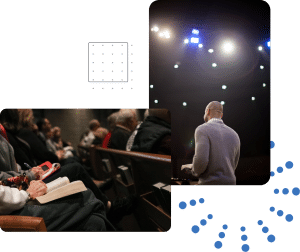
I had one of those rare Sundays off as a church leader yesterday. I went to our church, Connexus, with my family. (I took this picture from where we sat in the back row.)
I didn’t serve, I didn’t have any responsibilities, I simply attended.
Just like many people do every Sunday. And like any friend you or I will ever invite will do on their first Sunday.
Yesterday, I was reminded about the critical importance of how we do what we do when we design a Sunday service.
Increasingly I believe we will completely miss engaging unchurched people unless we’re intentional.
Why? Because almost everyone shows up to your church on Sunday distracted.
Here’s how I spent my Sunday yesterday:
- I got up early and ate breakfast.
- I read five chapters of the Bible (my regular devotions) and prayed.
- My wife Toni and I went on a pretty amazing 44 km (27 mile) bike ride on a perfect morning.
- I even prayed again for specific people on the last leg of the bike ride.
Then I hopped in the shower and we drove to church.
My state of mind when I got to church? I was completely distracted—just like most of the people (Christians and non-Christians) who show up at your church every weekend.
Here’s what was going through my head as I walked into the service:
- I was wondering how I was going to find my 17-year-old son who drove there separately (we found him during the first song and sat together).
- I was thinking about our bike ride.
- I was rehearsing conversations I’d had with people in the foyer on the way in.
Despite being a Christian, having read several chapters of the Bible and praying that morning and wanting to be in church, guess what I was not thinking about?
Engaging in the service.
Fortunately, our team has done a lot of work trying to counter that. Because we’re a North Point strategic partner, we follow the Rules of Engagement Andy Stanley has developed. (To read more about the Rules of Engagement, read Andy’s Deep and Wide. Chris Edmondson also has a helpful summary of the Rules on his blog.)
The basic premise of the Rules of Engagement is that you can’t assume you have the attention of the people who show up Sunday.
And you can’t just begin randomly. Or just unthinkingly use the same template that worked 30 or 300 years ago.
By moving them through a three part journey, you are far more likely to move them from where they were when they came in to a place of common connection.
We meet for 2 hours every Tuesday to evaluate last Sunday and plan future services using the Rules of Engagement.
Here’s how we design each service:
Engage.
From the parking lot, to the foyer to the opening portion of the service, we focus on engaging people as they come in. Recently when we were talking about serving, we called the Sunday “on board” and had some massive power boats in the parking lot, a surf theme in the foyer and ran this video during the welcome. Let’s just say when we were done, everyone was laughing, engaged and ‘present’.
A high-energy worship song, a song from the radio or even a bit of humour or sincere engagement by the host during the welcome can bring everyone to the place of attention.
Engaging is about finding common emotion and a starting point for the hour together. Often it’s not just about what you do, but how you do it. You might consider building a sense of transcendence using lights and sound (the modern day incense), or with silence, or surprise, or humour or common emotion. The point is to connect with people where they’re at and engage them.
Involve
Hopefully by this point, most people are engaged in the experience. During the second part of the service we focus on involving people.
This is where we do corporate singing (what many churches call ‘worship’). Unchurched people generally prefer shorter music sets (where else do you sing publicly these days?). We live with the tension of Christians who sing and others who don’t.
We do our baptisms during this window in the service, and the combination of a recorded video story for everyone being baptized and the live baptism is a powerful combination. People connect with story. Finally, if we do a popular song that sets up the tension in the message (like “Somebody that I Used to Know” by Gotye in a series on relationships) we’ll do it here. We also take up the offering.
The point is that by the time we get to the message, people are engaged and involved.
Challenge.
When it comes to the message, the process starts all over again. Whether Andy is teaching or I’m teaching, we almost always go back to common emotion. Andy did this incredibly well when he got everyone to think about how they compared themselves to others and the ugliness and futility that can create in all of us, regardless of what we believe (you can watch it here).
Jesus would often do this, saying things like “ever lost anything significant, like a sheep or a coin? You search high and low until you find it, right?” At this point, everyone can relate. Then Jesus lowers the boom “Or how about a son? That’s how your heavenly father feels about you.” The parable of the lost sheep, lost coin and lost son in Luke 15 show how powerful common ground paired with the Gospel really is.
The service ends with a challenge. Andy finished by encouraging us to only look to our heavenly father for a sense of our value.
I there is anything that offends people at all in the service, it should only be the Gospel, not the way we present it.
And you know what amazed me most yesterday? The process worked.
The service engaged me. At about 1o minutes in, I forgot what my issues were, and I was present. Listening. Open.
While no approach is perfect, I was so thankful that the way we designed the service ‘worked’ for me.
And—let’s be honest—how many people do you think show up at church having already read several chapters of the Bible and having prayed and having a vested interest in seeing the church thrive (I am the Lead Pastor after all).
If you’re going to reach unchurched people, you need to be intentional about what you do with your hour on Sunday.