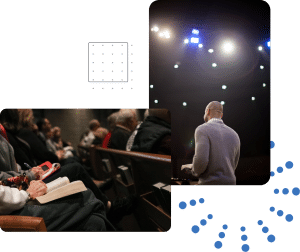
One of the questions I get asked all the time is “how do you speak for 40 minutes without using notes?”
It’s a great question.
Personally, I actually prepare notes, but I rarely if ever use them when I speak to an audience.
I create notes (sometimes even scripting out stories word for word) because:
Better preparation makes me a better speaker
Writing down my thoughts clarifies my thinking
My notes give me something to review the day before the talk and the day of the talk.
But then, when I get up on stage, I leave them behind. The only exception is if I need an outline to keep the computer graphics people in sync or I’m using a fill-in-the-blank handout for people—again, so I can track verbatim with their notes and keep us in sync.
And then, it’s just the outline that’s on the screen or in people’s hands that comes with me. No other notes.
Better preparation makes you a better speaker. Share on XBut I didn’t start this way as a communicator. Like most people, my first years of speaking were heavily reliant on notes.
I remember that moment early in my ministry when I finally freed myself of notes. It was nerve-wracking.
It’s actually not that hard to do, and it’s learnable. But it was so rewarding.
Using notes almost always makes you less effective as a communicator. And in the next post, I’ll look at how to deliver a talk without using notes.
In the meantime, you can trackback. So why should you learn to speak without using notes? Because you can. And because it will make you far more effective.
This post, by the way, is part of a bigger series on speaking:
- Part 1: How to Design a Message Series That Engages Unchurched People
- Part 2: How to Craft a Clear and Memorable Bottom Line for Your Next Sermon
- Part 3: 7 Reasons You Should Speak Without Using Notes (this post)
- Part 4: A 5-Step Method For Delivering a Talk Without Using Notes
- Part 5: 6 Sermon Myths We Need to Bust
7 Reasons You Should Speak Without Using Notes
So, why should you do the work and take the risk associated with freeing yourself from your notes? Let’s jump into some reasons. Because when you understand the why, you’ll be motivated to learn the what (the next post in this series).
There are at least seven good reasons to drop your notes:
1. Your favorite communicators don’t use notes
I’m going out on a limb here to guess that your favorite communicators don’t use notes. Why? Because the best rarely, if ever, do. People connect better with speakers who speak without notes. You do. So why not become one?
2. You seem far more sincere and authentic when you don’t use notes
This isn’t a good thing. It’s just a true thing.
You might be 100% sincere and authentic when reading from your notes. But you don’t come across that way.
When you read a talk, or rely heavily on your notes, people think it’s coming from your head, not your heart.
Or worse, they think it’s a series of points you’re supposed to believe but don’t. Freeing yourself up from your notes creates a much more believable message.
When you read a speech, people think you’re insincere and inauthentic, even when you’re not.
When you read a speech, people think you're insincere and inauthentic, even when you're not. Share on X3. You will be far more natural
There’s a ‘reading voice’ and a ‘speaking voice’ people have. It takes exceptional skill to read in a way that sounds authentic, conversational and natural.
Let’s be honest. Almost none of us do it well. I don’t, and chances are you don’t either.
When you speak without using notes, you will be far more conversational, engaging and natural. And your body language will be 100% better.
4. You can make eye contact
That’s just huge. It’s annoying when people don’t look you in the eye when they talk to you.
It’s completely disengaging when a public speaker doesn’t.
It's completely disengaging when a public speaker won't look you in the eye. Share on X5. You will read the room better
So much of communication is non-verbal. While you can’t always see the audience when you talk (in the case of pre-recorded video or dark house lights), when you can, it’s invaluable.
You can see which part of your talks are resonating, and which aren’t, so you can linger longer or move on faster.
You can see who’s leaning forward, and who’s falling asleep. It can help you track how you’re connecting.
And best yet, you can adjust.
6. You’ll own your material more deeply
When you have to ‘say it’ without notes, you’ll own it so much better. Learning your talk forces you to digest it, internalize and own it.
As a result, your talk will be more compelling and authoritative. It just will.
Learning to give your talk without notes will force you to digest it, internalize it and own it. Share on X7. You’ll be more vulnerable
Notes are safe. Speaking without them is more risky but more rewarding.
Sure, you might mess up, but laugh at yourself. People will laugh with you. They’ll like you because you’ll seem human, which, after all, you are.