


You know this as a preacher: patience is a Christian virtue, something you’re probably working on, and something you encourage people to develop.
Well, welcome to the age of AI, which brings with it a host of new challenges. Like this one. AI answers every question instantly. God, as you know, sometimes doesn’t answer at all.
That gap is about to become one of the biggest discipleship challenges the church has faced.
The Speed of Answers Has Historically Been Slow
Until very recently in the course of human history, every human being who ever lived dealt with delay.
If you wanted to know how something worked, you asked someone. Maybe they knew, maybe they didn’t. You lived inside the limits of your community’s collective knowledge. So sometimes you never found out, or you got the answer somewhere down the road.
The internet sped that up. But you still had to search and read the article, or watch the video. You still had to wait.
AI broke that model.
For the first time, one source can synthesize almost everything humanity knows into a single response, and it can do it instantly.
Think about it. There isn’t a topic AI won’t comment on—from troubleshooting your TV to the details of your medical diagnosis, from brisket recipes to Roman history, to writing your marriage vows or outlining your negotiation strategy with the IRS.
Whether AI is right or wrong, it always has an answer. It also has the confidence it’s right, even when it’s not.
That changes how people expect the world to work. And it will absolutely change how people expect God to work.
Meet the God Who Is Present—and Often Silent
Christianity is built on a relationship with a God who is real and present… but rarely instant.
God’s presence can be undeniable. It can also be quiet.
We worship an invisible, eternal God whose presence is palpable but mysterious. Suffering and silence are significant parts of the Christian journey. Even after you become a Christian, to not hear from God is a normal part of the experience—even a sign of maturity.
The dark night of the soul is something many of the most devout Christians have experienced. And it’s often a season of brutal silence and abandonment.
AI is always available. God is always present. Those aren’t nearly the same thing.
The Parable of the Persistent Impatient Widow
So what does this mean?
Well, imagine preaching a sermon on the persistent widow in Luke 18. She’s completely vulnerable in first-century Palestine. She’s been banging on the door of heaven and not getting an answer. And Jesus essentially says this is how it is—be persistent. It’s not going to happen overnight. And that’s faithfulness. Case closed.
So, imagine that after you preach that sermon and encourage people to persist in knocking on God’s door for months, years, and even decades as a model of faithfulness, someone driving home from your church has a conversation with AI on spiritual matters and gets instant, comprehensive answers.
The AI dialogue continues all day… all night… back and forth on demand. Let’s say it’s a “Christian” AI app.
What happens to patience? Faithfulness? Endurance? Resilience?
Jesus told his followers to keep knocking even when no one answers. AI answers before you finish the question. One builds faith. The other replaces it.
The Syncretism Problem
Already, AI apps, “Christian” and otherwise, that claim to speak for God are abundant allowing you to have a direct Q and A with ‘god’.
Except that’s not how God works. Not in Scripture, not in the millennia of the church.
AI might let you “chat” buddy-buddy with God, but in Scripture, if you had an encounter with God—a theophany—you pretty much fell dead, terrified and overcome by a complete unworthiness. A chatty app doesn’t quite capture that.
The real danger isn’t that people will reject God—it’s syncretism, the slow blending of AI’s immediacy with Christianity’s spiritual formation. To let AI define what we expect of God.
Play that out a bit, and increasingly, people will expect God to respond the way AI does—fast, clear, conversational, and, worst of all, predictable. A predictable God isn’t God. It’s a product.
The God of the Bible contradicts you, convicts you, and calls you to change. An AI god agrees with you, affirms you, and asks nothing of you. Only one of those is worth worshiping. The other, of course, is a cheap mirror.
A Countercultural Church
As often, the promise is in the problem: The more AI accelerates convenience and instant feedback, the more the authentic Christian life will stand out.
Gen Z’s renewed openness to Christianity in the 2020s isn’t because culture offered them nothing—it’s because culture offered them everything, instantly, and they found it hollow.
Pastors will need to help people understand that silence is not abandonment. That waiting is formation, not failure. That God is faithful even when he isn’t fast. And that the slow work of discipleship is more valuable than any instant answer an algorithm can generate.
The leaders who will matter most in the AI age won’t be the ones who move fastest. They’ll be the ones who refuse to trade the slow work of discipleship for the instant gratification of technology. I hope and pray that’s you.
In the meantime, the next time you preach the parable of the persistent widow, perhaps you should point out that the chat with AI on the way home isn’t actually a chat with God, and it’s probably not authentic spiritual formation.
AI and the Future Church: Make Your Ministry Irreplaceable in an Age of Artificial Everything
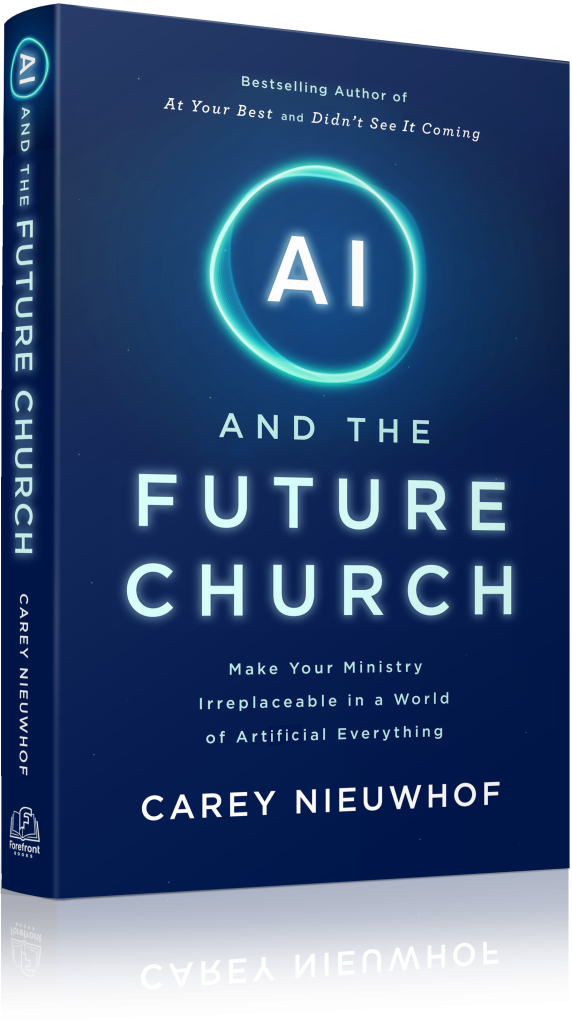
The AI era may be the greatest disruption the church has ever faced, and its greatest opportunity to reach more people.
Work is changing fast, mental health is declining, truth itself feels up for grabs, and people are searching desperately for something real. That something is Jesus, and your church is where they’ll find Him.
AI and the Future Church is my new book on the ministry, strategy, and ethical issues that AI poses for church leaders. In it, you’ll get the three shifts every church leader needs to build a ministry ready for today’s culture and whatever comes next.
- Order your copy today.
- Claim free bonuses.