

This post is in partnership with Subsplash, written by Jeff Harvey, Senior Content Manager. Subsplash is one platform that does it all—build your church community with the only platform made for discipleship.
There’s a pastor I know here in north Austin, Texas who can tell you exactly how many people walked through his church’s doors last Easter. He has the number memorized. He’s proud of it, and he should be. It took years to build a church that fills a room like that.
Ask him a harder question, though. Of everyone who came Easter Sunday, how many are still there now?
He doesn’t know. Nobody told him that number, so he never had to sit with it. And here’s the part that should bother all of us in ministry: not-knowing isn’t his fault. Nobody trained him to ask that question, and none of his church’s tools put the answer in front of him. He did everything right on the day that mattered most, and the church still doesn’t know what happened next.
This isn’t just a story about my pastor friend… It’s a story about what happens to good instincts when they run out of room to work.
Pastoral Instinct Was Never The Problem
My pastor friend’s instinct was never wrong; it just ran out of reach. Ask any pastor which of their people are drifting away, and they’ll usually know before you finish the question. They can tell you who stopped showing up to small groups, who’s been quietly serving on three teams without a break, or who lingered after service last week because they have no home to return to. That instinct is real, and it’s earned from years of hallway conversations, altar calls, and coffee after church.
A pastor’s intuition isn’t the issue; where it lives is the problem. As long as this knowledge stays in one person’s head, it only reaches the people that one person happens to see. That worked when a congregation fit in a small storefront, but it stops working the moment a church grows past what any one leader can remember.
This is where most conversations about church data miss the mark. They begin by asking what to measure: attendance numbers, giving volume, guest counts, as if the number itself were the goal. It isn’t.
We all know the goal is never the number; it is always the people behind it.
Data doesn’t replace a pastor’s instinct. When data is understood well, it extends the pastoral instinct by presenting information about the people a pastor hasn’t personally talked to this month.

From Measuring Data to Uncovering Real Needs
Just being able to track your church’s numbers is the wrong finish line…. so here’s the harder and more valuable question: What does a number mean once you’re holding it, and what does it show you as shepherd of your church?
A few examples of what this looks like in practice:
- A first-time guest who doesn’t come back isn’t just a failed follow-up call. It’s a question: what happened, or didn’t happen, between week one and week four? Sometimes the answer is a broken process. Sometimes it’s a person who needed someone to notice them, and no one did.
- A shrinking share of people tithing is more than a budget problem. Generosity is a spiritual discipline before it’s a revenue line item. When participation drops even while total dollars hold steady, the real story is how many people have quietly stopped practicing generosity at all. That’s a discipleship conversation for your pastoral team rather than a question for a finance committee.
- A high percentage of people leaving small groups is a belonging problem before it’s an engagement problem. People can hear good teaching every week and still have no one to call their friend who’d notice if they disappeared. That gap is where faith stalls out quietly, long before anyone officially calls it a crisis.
- A wide space between “I’m interested” and “I actually belong”—a class, a baptism, a next step—is where pastoral care shines. Interest that never turns into action usually means someone hit a moment of doubt or logistics alone. A conversation closes that gap far more often than a better sign-up form does.
None of these examples are complicated. What they share is a missing habit of pausing on the number long enough to ask who it represents, not just what it totals.

How Do You Address This?
Well, one way is to create a database or spreadsheet with the data you want and check it monthly. The problem with that it’s heavily dependent on a person maintaining and interpreting the data points and knowing what to do with them regularly.
Reading data takes more from a leader than glancing at a dashboard once a month. It means viewing numbers through a shepherd’s eyes rather than an administrator’s spreadsheet, and it means treating a downward trend as an invitation to a conversation, not a problem to explain away.
But… the data has to be within reach in the first place. Most church leaders have good instincts but lack a way to see enough of their congregation’s engagement to know where to point that instinct next.
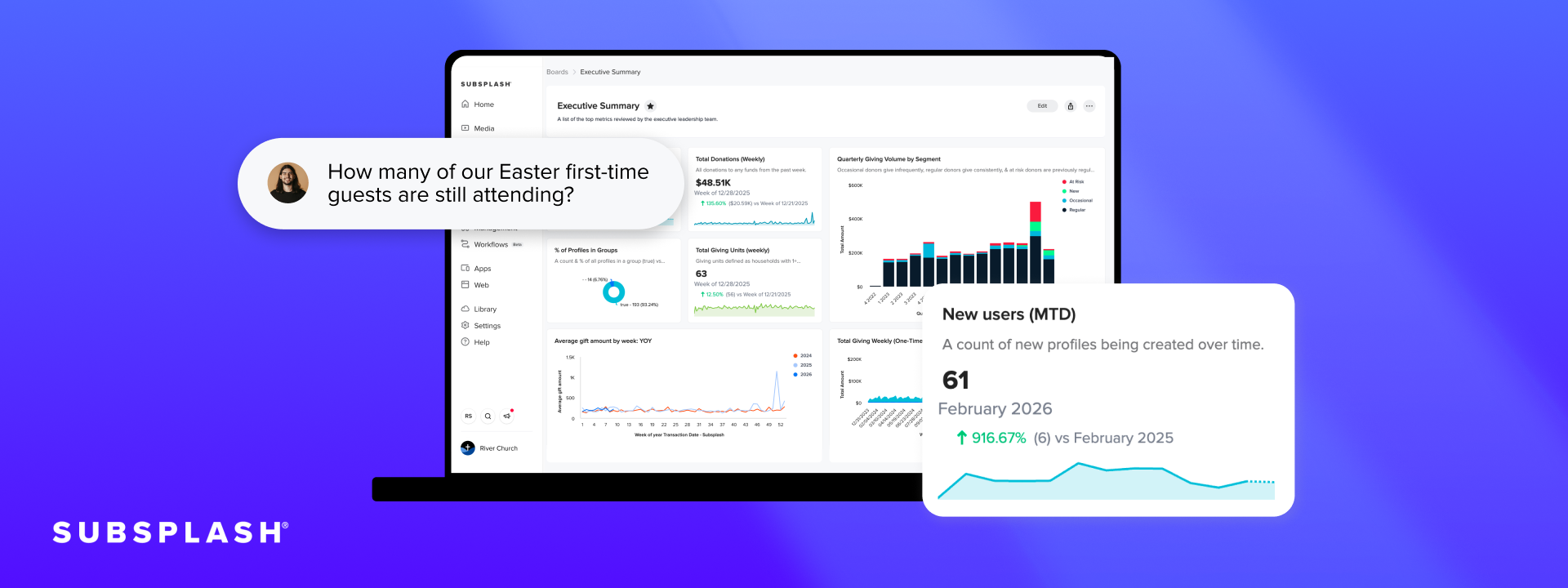
Another way is with Trends AI by Subspash. That’s exactly the gap it was built to close. It pulls your people’s data, giving numbers, attendance activity, and more into one place and lets you ask plain-language questions about your own church’s engagement to get real answers. This ensures the pulse a pastor already has on their people doesn’t have to fade just because the church grew too big. Trends AI surfaces the numbers and trends and helps point out the gaps. What you do with that is still up to you.
The leaders who disciple well over the next decade won’t be the ones with the most data. They’ll be the ones who found a way to keep seeing people as their churches grow past what one person can remember alone.
Learn more about Trends AI and see for yourself how it can deepen your discipleship.
Learn More TODAY