


For all of human history, death has been final. AI is about to make it feel optional.
And if that’s the case, what does that do to sound theology, your church, and your congregation?
Let me explain.
Mom’s Dead, But Hang On, Let Me Talk To Her
In November 2025, an actor named Calum Worthy posted a promotional video on X for an app he’d co-founded called 2wai. The clip showed a pregnant woman video-calling an AI recreation of her late mother for advice, then fast-forwarded: the same avatar reading bedtime stories to her newborn, then counselling her adult grandson.
All of it was generated from three minutes of footage of the mom before she died. The tagline: “With 2wai, three minutes can last forever.” The video racked up 22 million views. Much of the response was horror. Users called it “nightmare fuel,” “demonic,” and an exploitative commercialization of grief.
Zelda Williams, Robin Williams’ daughter, had already publicly condemned AI-generated videos of her father as “disgusting” and deeply disrespectful. None of that stopped the app from launching.
2wai isn’t the only company. Startups like HereAfter AI, Eternos, and ElevenLabs are building what the industry now calls “grief tech.” All services that recreate voices, faces, and conversation patterns of the deceased for ongoing interaction.
Researchers at the University of Cambridge have also warned of what they call “deadbots,” AI reconstructions that could cause profound psychological harm, including “digital hauntings” where people become unable to move on. As one researcher put it, these services “run the risk of causing huge distress… particularly at an already difficult time.” The market is being built anyway.
I Want To Be Forever Young
Summoning the dead is one thing. Never dying is another.
Bryan Johnson, who sold his company to PayPal for $800 million, now spends $2 million a year on “Project Blueprint” (a regimen of blood tests, DNA editing, and supplements designed to reverse his biological age).
His stated philosophy: “Don’t die.”
He believes death is optional and plans never to do it. He’s not alone.
Oracle’s Larry Ellison has spent hundreds of millions funding anti-aging research because, he says, “death makes me very angry.” Google co-founder Sergey Brin has said he hopes to “cure death.” Peter Thiel has expressed interest in parabiosis, blood transfusions from young donors, as a longevity strategy.
So What Does This Mean?
So most people aren’t billionaires, and the comments on the 2wai piece suggest quite a bit of horror. But don’t dismiss this out of hand.
The likelihood that the idea of erasing death creeps into the popular psychology of ordinary people is quite high. You already serve a community and congregation where people are embracing all kinds of health hacks and wellness schemas, from protein fueling to botox and lip fillers, to consulting mediums to connect with deceased loved ones (yes, someone in your church is doing that right now). Expect that to greatly intensify.
In many ways, escaping death and keeping loved ones alive is a product of a society that’s lost its Christian grounding. It’s a form of idolatry in that, when there’s no God to cling to, we put another human in that place instead. And if we never have to “lose” that person, well then, we think our needs are met.
The technology to keep dead loved ones alive may be designed to heal. But what if it prevents healing instead?
A Faith Built Around Death (and Resurrection)
Christians cannot escape the centrality of death to the Christian gospel.
Theologically, the entire Christian faith is premised on death and resurrection. From the literal death and resurrection of Jesus to the symbolic but also very real death to self of Christian discipleship, to the hope that all who die in Christ will be raised to life, Scripture is paved with language, stories, theology, and journeys around death.
The Christian faith doesn’t promise escape from death. It promises something better—that death doesn’t get the last word.
I mean, I get it. Death shatters us. But it’s supposed to.
Further, God made death and resurrection the centerpiece of the human story of redemption. The one thing we couldn’t conquer, he did.
Meanwhile, guiding people through the valley of the shadow of death continues to be one of the greatest challenges and opportunities pastors and church leaders face.
In the Age of AI, the World is Going to Need More Pastoring
Flipping back the clock a few decades to a less technological time, an experience I had as a young pastors still brings the church’s role in death and resurrection into sharp focus.
A year into becoming a pastor, I heard the story from some of my congregation about two teens—cousins—who had died twenty years earlier. The boys, aged sixteen and eighteen, took a canoe out on a big lake north of Toronto in May. The air was warm, but the lake water was still cold, having been frozen solid two months earlier.
The boys never returned. Search parties looked for days, but to no avail. After coming to the point where the families realized their boys had, in all likelihood, perished, they delayed the funerals, hoping to retrieve the bodies. Days became weeks, which became months, which became years, which in turn became decades.
By the time I arrived, there had still never been a funeral or memorial service.
I went to visit the fathers who had lost their boys and asked if a funeral would be helpful. They thought it would.
A few weeks after that visit, we gathered close family and friends at our little church and bid a final goodbye to the boys. The grief was as palpable as it would have been had they died a few days earlier. But now, finally, there was closure. And now, finally, they could move on. The family was so grateful.
Twenty years of grief, released in a single afternoon. That’s what closure does. And that’s what AI resurrection threatens to steal.
What happens when that closure never comes? What happens when, instead of a funeral, you just open the app?
AI Resurrection Is a Cruel Counterfeit of Christian Hope
What if AI induces people to abandon grief rituals entirely, even to pretend as if a death never happened? As a pastor, what do you do?
You can get started by helping your congregation understand that death is not the enemy to be avoided at all costs but the gateway to resurrection.
If anyone knows how to “do death,” it’s Christians.
When you regularly preach and disciple people to know that Christian hope isn’t about preventing death or artificially extending earthly life, but about the promise of true resurrection and reunion in Christ, people will begin to see that this is something they can embrace, as hard as it is.
And don’t wait until someone in your congregation has already paid for a subscription to one of these services. Teach about this technology now—what it is, why it will be tempting, and why it’s spiritually dangerous. Help people understand that these AI simulations are not their loved ones but sophisticated impersonations that can trap them in a false reality and prevent them from moving forward.
If the ship has already sailed and someone admits they’re using AI resurrection services, treat it the way you’d treat any confession of struggle—with compassion, not condemnation. Empathize with them. Walk alongside them. Help them see that, while their longing for their loved one is beautiful and understandable, this artificial perpetuation isn’t truly honoring either the deceased, The Gospel, or themselves.
The antidote to AI resurrection is embodied presence in the face of real death. The church has always offered that. It’s time to lead on it. Especially in the age of AI.
AI and the Future Church: Make Your Ministry Irreplaceable in an Age of Artificial Everything
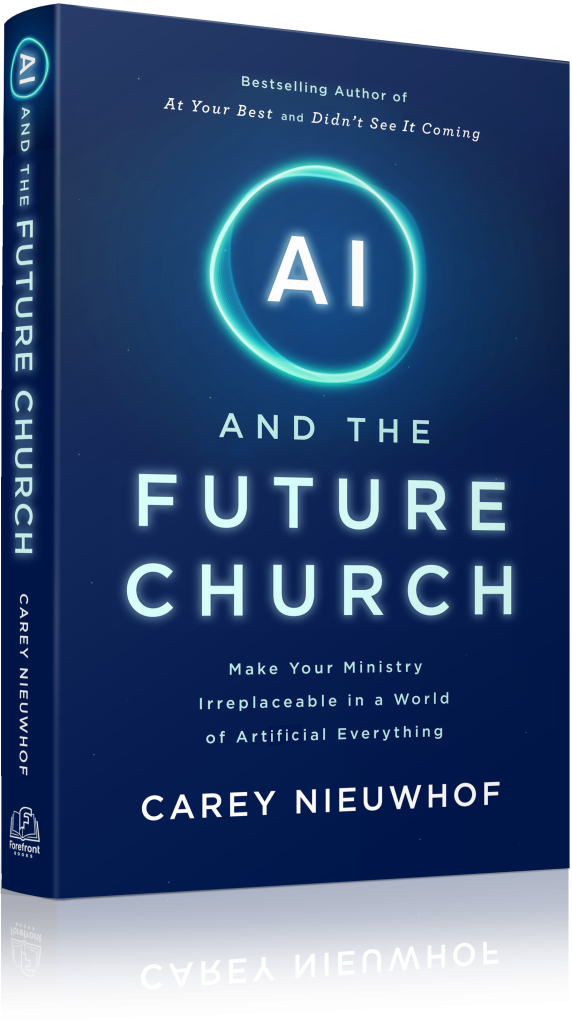
The AI era may be the greatest disruption the church has ever faced, and its greatest opportunity to reach more people.
Work is changing fast, mental health is declining, truth itself feels up for grabs, and people are searching desperately for something real. That something is Jesus, and your church is where they’ll find Him.
AI and the Future Church is my new book on the ministry, strategy, and ethical issues that AI poses for church leaders. In it, you’ll get the three shifts every church leader needs to build a ministry ready for today’s culture and whatever comes next.
- Order your copy today.
- Claim free bonuses.