One of the most pressing questions church leaders face is also one of the most complex: “How do I know what to pay our church staff?”
Set pay too low, and you risk losing talented team members or burning them out. Set pay too high, and you may strain your budget and limit ministry impact. Unlike the corporate world, ministry compensation has unique dynamics that make simple benchmarks unreliable.
But with the right data, you don’t have to guess.
Here are five factors to guide your church toward fair, sustainable compensation.
1. Start With Your Budget and Giving Trends
Always start by evaluating staff pay in light of your overall budget. Pay is most strongly correlated with the financial size of your organization. This is because churches with similar budgets can afford to offer similar pay—both their staff size and resources are extremely similar.
Attendance is much less helpful when comparing pay than most churches assume, since giving levels vary between churches.
Depending on the average per person giving, a church with 400 people could have:
- A $500K budget—based on $1,250 per person
- Or $1M budget—based on $2,500 per person
A $1M church will function, pay, and look very different than a $500K church, even though they may both have 400 people.
By focusing on the financial size of your organization (total operating budget) first, you can ensure that your pay comparisons take into account differences in giving that will not be apparent if you only look at attendance.
2. Factor in Church Size and Location
While pay does vary between churches based on size, this is also driven by giving (as we noted above).
Size matters most when it comes to evaluating an individual’s level of responsibility and the scale of their role on staff.
ChurchSalary’s research indicates that there are three main salary grades for pastors in the United States. They are driven by the scale of these pastoral roles:
- Senior/Lead & Executive Pastors – Responsible for the entire church and finances.
- Associate, Adult Ministry, Christian Education, & Worship Pastors – Responsible for caring for adults, who comprise the largest segment of the congregation.
- NextGen, Youth, and Children’s Pastors – Responsible for children, youth, and college-aged members, who are typically the smallest segment of the congregation.
Church size also impacts the level of education, experience, and talent that churches expect of their staff; larger churches often require specialized roles, while smaller churches lean on hybrid positions.
Location influences pastoral pay but not as much as most people assume.
In part, this is because the search market for most pastoral positions is nationwide. Additionally, while the cost of housing varies greatly in some coastal areas and major cities, most people in the US encounter similar costs.
Finally, even where costs are high, churches are limited in their capacity to adjust pay based on local economic factors. Rely on resources that enable you to analyze the impact of location and avoid averages that claim to be local but ignore the impact of factors such as church budget.
3. Look at Roles and Responsibilities (Not Just Titles)
Job titles don’t always tell the full story.
Many churches employ staff in hybrid roles—for example, “Youth and Worship Pastor” or “Admin and Tech Director.”
Compensation should reflect the scope of responsibilities and the time invested, not just the label on the business card.
The ideal way to benchmark hybrid roles is by breaking down a hybrid employee’s responsibilities or hours into a percentage mix of up to three different positions.
If you know that your Youth and Worship Pastor spends 30% of their time working on worship-related tasks and 70% of their time ministering to youth, you can more accurately price their position.
4. Compare to Ministry-Specific Data (Not Generic Sites)
Generic salary calculators often pull from broad labor markets that don’t account for the unique dynamics of ministry.
This can create misleading benchmarks.
The biggest red herring is nationwide catch-all averages for all “senior pastors”—as these numbers don’t account for differences in church budgets.
Churches need ministry-specific data. Over the years, ChurchSalary has generated more than 100,000 reports, drawing from 40,000 employees at 22,000 churches nationwide. That means you’re not guessing—you’re comparing against verified compensation data from actual ministry contexts.
When making decisions that affect both staff livelihood and church stewardship, accuracy matters.
5. Plan Ahead for Raises and Retention
Fair pay isn’t just about where salaries start—it’s about how they grow. Churches that neglect to give raises risk higher turnover and lower morale.
In last year’s State of Church Compensation Survey, 47% of churches indicated that they planned to increase salaries between 3 and 5% to account for the impact of inflation and market pressures. These COLA (cost of living adjustment) changes function as a baseline to account for inflation, and churches typically offer merit increases on top of this baseline.
If your church doesn’t pay attention to market trends, you could easily fall behind and run the risk of alienating staff and creating turnover (or burnout). Thinking proactively about raises helps churches retain gifted leaders and sends a clear message: we value you and your ministry here.
Are You Getting Paid Fairly? Get ChurchSalary’s Free Preview Report.
At the end of the day, fair pay is one of the most tangible ways a church can show care for its staff. When leaders make decisions based on reliable data and healthy benchmarks, they not only steward resources well but also build trust with their team.
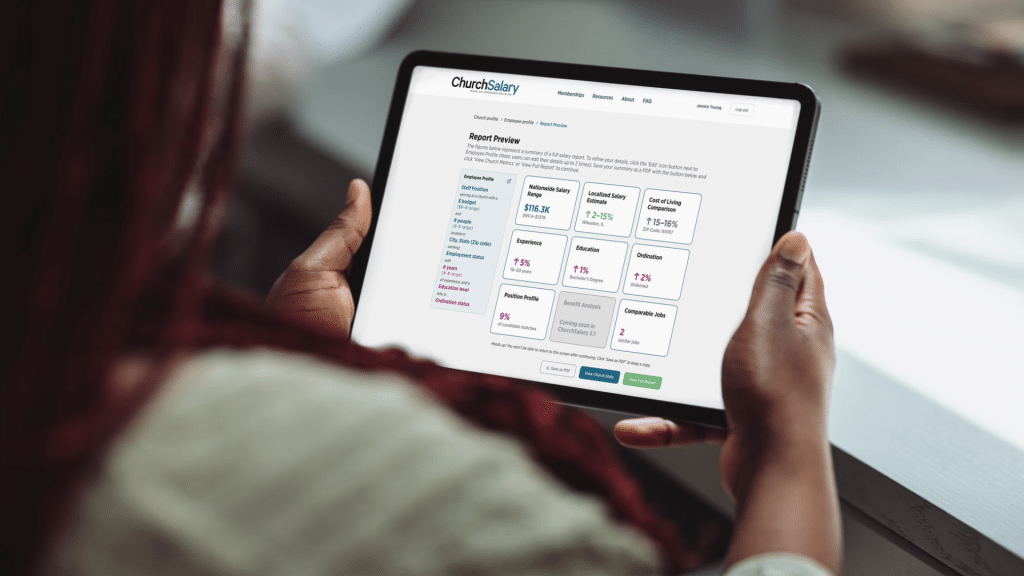
One tool that churches across the country are using is ChurchSalary. And with the launch of their new 3.0 platform backed by real-world data from thousands of churches, fair pay decisions have never been easier. In a few clicks, you can benchmark salaries with precision and honor your team with trustworthy salary reports.
To see how it works, you can get a free salary report preview to see how your staff compares to ministry leaders nationwide.
At a cost of only $12–$14 per employee, a ChurchSalary membership optimized for the size and needs of your church can provide you with customized salary reports, in-depth cost-of-living and demographic analysis, hybrid salary reports, and a groundbreaking new market survey tool that allows churches to price senior staff.
The next step is simple. Use data, not guesswork, to make pay decisions your staff can trust and your budget can sustain.