

This post is in partnership with Global Christian Relief, written by Brian Orme, CEO of Global Christian Relief
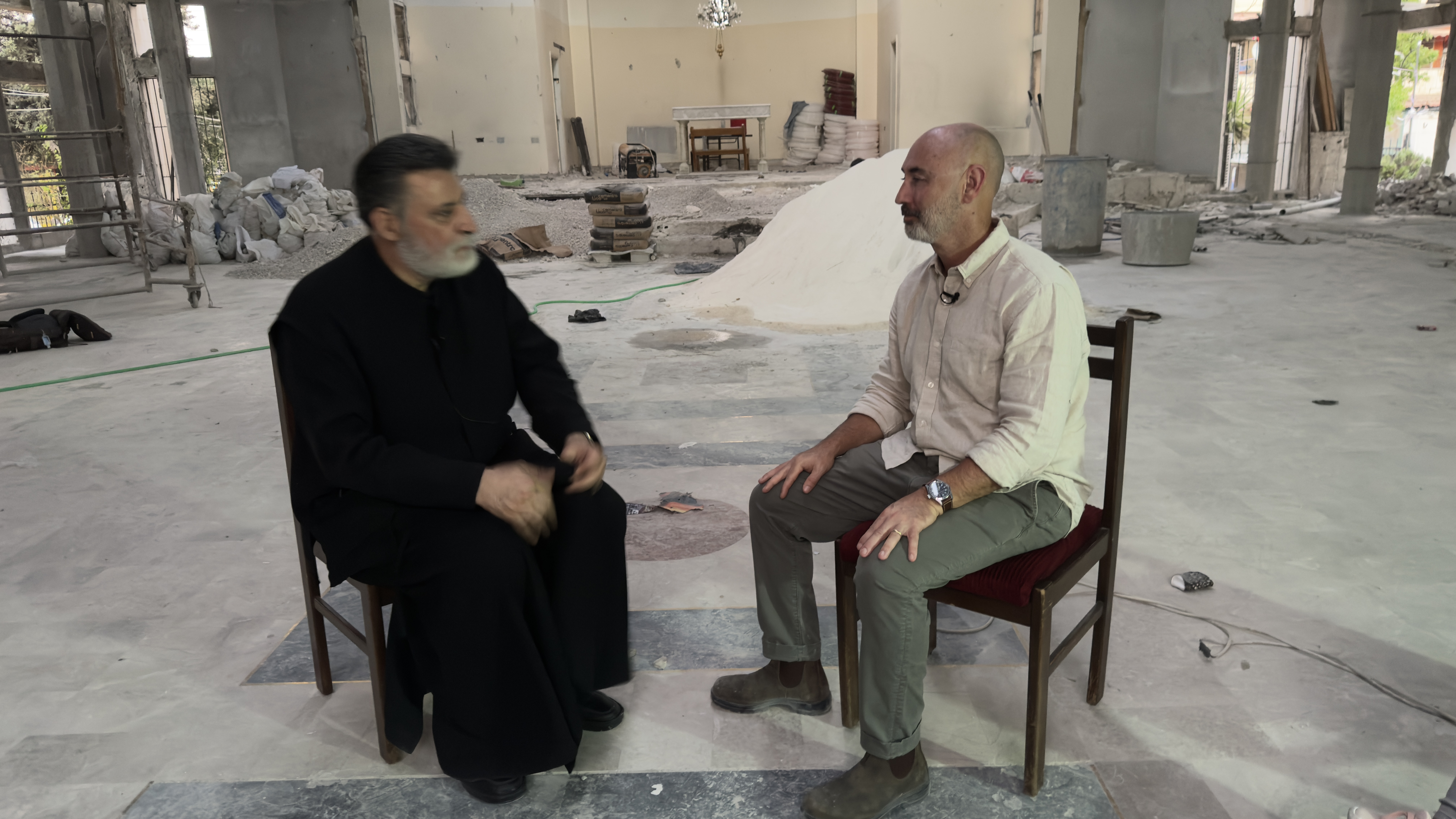
Father Boutros and I sat in front of a large wooden board near the entrance of Mar Elias Church outside Damascus, Syria. The board covered a hole in the ground. On it sat a single candle.
Around us: construction dust, piles of debris, scaffolding against the walls.
Just weeks earlier, June 22, 2025, a suicide bomber had detonated his vest at that spot during a prayer meeting, taking the lives of 24 church members.
Father Boutros was there that evening. When the blast went off, he thought he had died. When he regained consciousness, he began running triage for his own congregation.
The stories from that night, stories of loss, tragedy and fear, but also of selfless action, love and courage, are still sending ripples through the Christian community in Syria.
More than a year later, Father Boutros and the leaders of Mar Elias are still picking up the pieces. But the call to lead, to serve the church in whatever context God places you, remains as real as ever.
“As long as one candle remains here in Syria, the church will continue,” he told me, sitting in front of the blast site.
Over the last 10 years, I’ve sat with hundreds of persecuted believers in every corner of the world. I’ve worshiped next to them in makeshift homes and large cathedrals. I’ve prayed with them and cried with them.
These brothers and sisters in Christ have become my spiritual mentors. As the CEO of Global Christian Relief, I get to be part of helping millions of persecuted believers every year, but I’m convinced I’ve gained far more from them than they have from me.
Here are five of the most important leadership lessons they’ve taught me.
1. God Does Some Of His Deepest Work Through Suffering
For most of my life, I looked to the mountaintop experiences as the moments God used to shape my heart: revival services, summer camps, deeply personal encounters with the Lord.
And those moments are real. God meets us there. Some of my own defining spiritual memories happened on the mountaintop, and I wouldn’t trade them.
But the persecuted church has shown me they’re only part of the story. If the mountaintop is where God gives us a vision of who He is, the valley is where He forges who we are. Scripture bears this out: far more of God’s formative work happens in exile, in prison, in the wilderness, than on the mountain.
I’ve seen what that kind of faith looks like, not in comfortable churches with polished sermons, but in brick kilns, refugee camps and underground churches. In these places, following Jesus costs everything. And many of our brothers and sisters choose Him anyway.
A few years back, I saw this come to life in an Indonesian mother who lost two sons in a church bombing. When I visited the site with her, I asked: “What gives you courage to stand here?” As a father of four sons myself, her answer shook me.
“I don’t want the extremist to win and put fear into my heart,” she told me. “To overcome evil with good is to remember my sons and their sacrifice and remember my Savior in this spot and not let the terrorist win.”
That’s the kind of faith forged in the valley. God uses these moments to show us He is real. His promises are real. He can be trusted. His Church will not be defeated.
Persecuted believers don’t want suffering. No one does. And they know suffering isn’t a punishment. But our persecuted family understands it as part of the Christian life, and they’ve learned what I’m still learning: through suffering, God does some of His deepest work.
2. Resilience Is The Daily Decision Not To Shrink Back
When many of us look at the persecuted church, we’re struck by the dramatic moments, the single, costly choice to follow Jesus no matter the consequences. I hear these stories regularly from believers around the world, and they never stop inspiring me.
A few years ago, I met an Iranian believer who had been imprisoned for his faith. He was a former Muslim who found Jesus, started a house church and did whatever it took to tell others about Him. One night, the authorities handcuffed him, blindfolded him and took him to prison.
Night after night, they interrogated him from midnight to 4 a.m., demanding the names of the other believers in his network.
All of us listening to his story were in tears. We had to stop and regroup. Yet as he continued, he told us what a joy it was to suffer and not shrink back from following Jesus.
Here’s what I’ve come to understand: that moment in the interrogation room was not where his resilience was made. It was where his resilience was revealed.
His boldness didn’t appear overnight. It was born from thousands of ordinary decisions to follow the Lord when the consequences weren’t severe. He could refuse to hand over his friends at 2 a.m. because he had already spent years sharing Christ on the streets at 2 p.m., knowing prison could come at any time.
Perseverance under extreme pressure is built from faithfulness under ordinary pressure.
This is where the persecuted church confronts me as a leader. Because the goal of leadership isn’t to start well, or even to peak well. It’s to end well. And most leaders don’t fall in a single dramatic moment. We shrink back by degrees. A compromise here. A quiet quit there. A slow drift no one notices until the drift is the direction.
The believers I’ve met from Iran, Syria, and North Korea have taught me that finishing the race isn’t decided at the finish line. It’s decided today, in decisions so small no one else sees them.
So when we hear stories like my friend’s, we’re tempted to ask, “What would I do under interrogation at 2 a.m.? Would I give up the names of my friends?”
But the better question is: “What am I doing with today’s small decisions to follow Jesus?”
Because those decisions, not the hypothetical dramatic ones, are quietly determining whether we make it to the end.
3. Forgiveness Is Obedience, Not Merely Emotion
If you ever meet my friend Suzanne, you won’t forget her. You’ll notice her hard-won joy the moment you meet her.
Suzanne is one of roughly 3.6 million Nigerians displaced amid years of violence and instability. She fled her home to escape Boko Haram, but when she returned to check on her father, they were both captured.
The militants shot and killed her father in front of her. Then one of her captors turned his gun toward her: “Choose. Will you follow Islam and deny Christianity, or do you want to die right now?”
Suzanne cried out to Jesus right there, choosing Him despite the cost. They shot her in the head, leaving her blind, but alive.
You might expect that experience to leave her bitter. The opposite is true.
She has forgiven her attackers. Not in theory, in specifics. She told me that if she met them today, she’d invite them to a meal and give them money for their trip home.
“I’d tell them they didn’t know what they were doing,” she says. “They need to know Jesus.”
Notice what Suzanne doesn’t say. She doesn’t say she feels forgiveness. She doesn’t say the wound has healed or that time has softened the memory.
When I asked her how she could forgive, she answered in five words: “Because Christ told me to.”
For Suzanne, forgiveness isn’t an emotion she waited for to arrive. It’s a command she chose to obey, and kept choosing, long before her feelings caught up, if they ever fully have.
Nobody leads for long without collecting wounds: the betrayal by someone you developed, the board member who blindsided you, the criticism from people you sacrificed for. Our wounds are smaller than Suzanne’s. Somehow our unforgiveness is often bigger.
And unforgiveness doesn’t stay private. A leader nursing a grudge eventually carries it into the way she leads, trusts and loves others.
Suzanne, blind and fatherless, is freer than many leaders I know with far lighter stories.
4. Loss Can Clarify Joy And Allegiance To God’s Kingdom
When I was a pastor, I held the persecuted church at arm’s length. I assumed their stories would be a dark room I’d have to walk into, something that would leave me feeling heavier, guiltier, worse.
That’s been the biggest surprise of the past decade.
Yes, there are heavy moments in these conversations. But the hours I’ve spent with persecuted believers are some of the most joyful of my life. Many of the meals and cups of tea we’ve shared have been full of laughter.
I’ll never forget sitting with families of martyrs in Egypt. I braced myself for grief, and the grief was real. The pain was obvious.
But so was something else.
They laughed. They loved music. And they teased each other. It felt less like a memorial and more like a church potluck with some of the funniest people I’ve ever met.
These were ordinary people who had lost the ones they loved most in a single tragic attack, and still said Jesus was worth it.
How?
I’ve come to believe loss had burned away everything secondary. These families weren’t joyful because their grief had disappeared. They were joyful because loss had clarified exactly what they couldn’t lose. Their treasure was already somewhere no gunman could reach.
Most of us never get that clarity because we’ve never been forced to sort our lives into what can be taken and what can’t. We grip our platforms, our budgets, our reputations, our growth numbers as if those were the kingdom. Persecuted believers have lost things infinitely more precious, and yet they have discovered something that cannot be taken from them.
That’s the question their joy has pressed into me as a leader: If everything I’ve built were taken tomorrow, would Jesus still be enough, or have I been serving the ministry more than the Master?
5. The Persecuted Church Needs Us, And We Need Them
The needs of persecuted believers are vast. Many have given up everything to follow Jesus. They need food, trauma care, a safe place to meet, and much more.
But when you ask them what they need most, the answer is almost always the same: pray for us.
They ask for prayers for their protection, their resilience, their freedom. And again and again, they tell us they can feel the prayers of believers around the world.
I used to receive that as a lovely sentiment.
I don’t anymore.
Hebrews 13 and Matthew 25 remind us that standing with suffering believers is not a specialized calling for a handful of Christians. We belong to one another. We share the same Holy Spirit. When one part of the Body suffers, the rest of us are not spectators.
But I’ve also come to understand something else. This relationship is not one-way; the persecuted church needs our prayers, our resources and our presence.
But we need their witness.
We need believers like Father Boutros and Suzanne reminding us what faith looks like when comfort disappears and following Jesus carries a cost.
They have become some of my most important spiritual mentors.
So here’s my closing question: Who from the global church is speaking into your leadership?
A few weeks ago, I walked back into Mar Elias Church, the same sanctuary where Father Boutros and I once sat in front of a wooden board covering a blast hole, a single candle burning against the dust and debris.
The dust is gone. The scaffolding is gone. The place where the bomb detonated is now a memorial of glass, light pouring through the spot where members of this church lost their lives.
I asked Father Boutros what carried them through the past year. He didn’t hesitate.
“The prayers of Christians around the world. We feel them. They give us strength.”
I keep thinking about what it means to lead a church through something like this. To stand among the dead and wounded of your own congregation, then wake up the next morning and begin caring for whoever remains. To bury people you love, to rebuild, to preach again, to gather people again in the same place where someone tried to kill them for gathering.
Most of us will never be asked to lead through anything like that.
But this is what the persecuted church has taught me: Christian leadership has never depended on favorable circumstances. The first leaders of the Church knew prison, violence, displacement and death. They kept going because they believed Jesus was alive, His promises were true, and His Church still had work to do.
Two thousand years later, Father Boutros believes the same thing.
The book of Acts is not a story we finished reading. In places like Syria, Iran, Nigeria and Pakistan, I have watched its story continue in the lives of ordinary believers who still choose Christ when following Him costs something.
That should change the way we lead.
We should lead with the conviction that Acts has not closed. That God is still at work in His Church. That suffering does not get the final word. And that even in the worst imaginable circumstances, there is still reason to get up tomorrow and faithfully do what God has put in front of us.
That is the hope I saw at Mar Elias.
Not that the worst won’t happen.
But that Christ will still be there when it does.
Stand with Christians who refuse to shrink back. Learn how Global Christian Relief serves persecuted believers and helps ensure no Christian stands alone.